
Rethinking the Global Economy

Rethinking the Global Economy
Structural Challenges, Systemic Risks, and Pathways to Renewal

February 2026 by Petrus Van Der Merwe

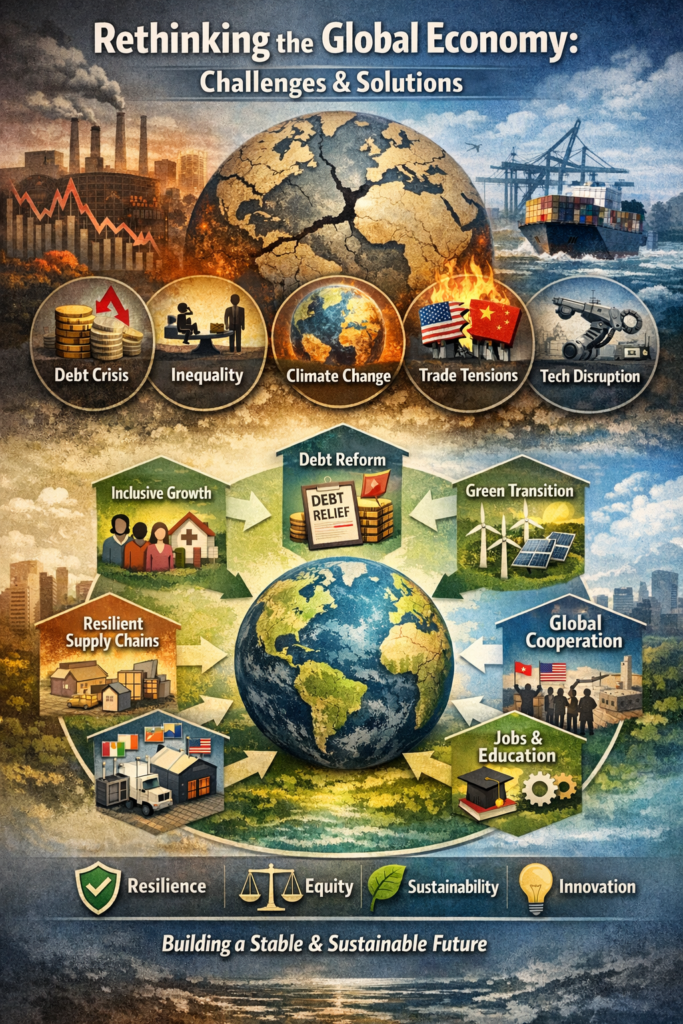
The global economy stands at a historic turning point. Decades of rapid growth, technological advancement, and global integration have delivered unprecedented wealth and lifted billions out of poverty. Yet beneath this progress lie mounting structural weaknesses: rising inequality, unsustainable debt, climate instability, geopolitical fragmentation, and technological disruption.

The question is no longer whether the global economic model faces strain — it is whether it can adapt fast enough to avoid prolonged instability.

This article examines the major problems confronting the global economy today and explores practical, systemic solutions capable of delivering long-term resilience, equity, and sustainable growth.

1. Slowing Growth and Structural Stagnation

The Problem

After decades of expansion, many advanced economies are experiencing slower productivity growth, aging populations, and declining labour-force participation. Emerging markets face volatile capital flows, commodity dependency, and external debt pressures.

Low productivity growth weakens wage increases, reduces government revenue, and limits investment capacity. In advanced economies, demographic shifts — particularly in Europe and East Asia — are shrinking working-age populations, increasing the fiscal burden on social systems.

Meanwhile, supply chain disruptions exposed during the COVID-19 pandemic and geopolitical tensions have revealed structural fragility in global trade systems.

The Solution

Investment in productivity-enhancing sectors is essential. This includes:

  • Digital infrastructure

  • Advanced manufacturing

  • Clean energy systems

  • Education and lifelong workforce retraining

Countries like South Korea demonstrate how sustained investment in innovation and human capital can offset demographic decline.

Policy reform must also encourage:

  • Labour force participation (especially among women and older workers)

  • Smart migration systems to address demographic imbalances

  • Targeted industrial policy to support strategic sectors

Growth must shift from quantity to quality — from expansion driven by extraction and debt toward innovation-driven productivity.

2. Rising Global Debt and Financial Fragility

The Problem

Global debt — sovereign, corporate, and household — has reached historic highs. Years of low interest rates encouraged borrowing, but tightening monetary policy has exposed vulnerabilities.

Emerging economies are particularly at risk. Countries facing high external debt burdens struggle when currencies depreciate and refinancing costs rise. Debt distress can trigger capital flight, austerity cycles, and social instability.

The global financial system remains interconnected and susceptible to cascading shocks.

The Solution

  1. Debt restructuring frameworks must be modernized and accelerated.

  2. Multilateral institutions such as the International Monetary Fund and World Bank need expanded capacity and reform to better support vulnerable nations.

  3. Greater financial transparency and regulation of shadow banking systems is necessary.

  4. Long-term fiscal discipline must be paired with strategic public investment — not austerity alone.

Sustainable public finances require growth, not just cuts.

3. Inequality and Social Fragmentation

The Problem

Wealth inequality has widened significantly across and within nations. A small concentration of individuals and corporations controls an increasing share of global assets.

Stagnant wages, rising housing costs, and automation-related job displacement have eroded middle-class security. Economic inequality feeds political instability, populism, and declining trust in institutions.

Economic systems perceived as unfair ultimately lose legitimacy.

The Solution

  • Progressive tax reform

  • Closing tax havens and corporate loopholes

  • Investment in affordable housing and healthcare

  • Strengthened social safety nets

  • Universal access to quality education

Nordic economies such as Sweden demonstrate that high competitiveness can coexist with strong social protections.

Inclusive growth is not anti-market — it stabilizes markets by strengthening demand and social cohesion.

4. Climate Change and Environmental Degradation

The Problem

The global economy remains heavily dependent on fossil fuels. Climate change introduces systemic risks:

  • Extreme weather disruptions

  • Agricultural instability

  • Infrastructure damage

  • Insurance market stress

  • Supply chain volatility

Unchecked climate change threatens trillions in economic losses.

The Solution

The transition to a low-carbon economy is not merely environmental policy — it is economic modernization.

Key measures include:

  • Carbon pricing systems

  • Renewable energy expansion

  • Electrification of transport

  • Green industrial policy

  • Climate adaptation investment

The European Union Green Deal illustrates how climate policy can function as a growth strategy.

Clean energy investment is increasingly cost-competitive and job-creating. The transition must be accelerated but managed equitably.

5. Geopolitical Fragmentation and Trade Realignment

The Problem

Globalization is evolving into regionalization. Trade tensions between the United States and China have reshaped supply chains. Sanctions, export controls, and strategic decoupling are redefining global trade architecture.

This fragmentation reduces efficiency, increases costs, and heightens uncertainty.

The Solution

While strategic diversification is rational, complete fragmentation is economically destructive.

Solutions include:

  • Strengthening multilateral trade frameworks

  • Modernizing the World Trade Organization

  • Building resilient, diversified supply chains

  • Establishing guardrails for economic security without total decoupling

Global cooperation remains essential for financial stability, climate response, and technological governance.

6. Technological Disruption and Labour Market Transformation

The Problem

Artificial intelligence, robotics, and automation are reshaping labour markets at unprecedented speed. Productivity gains may increase, but displacement risks are real.

Without proactive adaptation, automation could deepen inequality and fuel unemployment in certain sectors.

The Solution

  • Massive investment in reskilling and lifelong learning

  • Public-private workforce partnerships

  • Updating education systems for digital fluency

  • Portable benefits for gig and nontraditional workers

Technology must augment human productivity — not replace human dignity.

Governments that treat education as continuous infrastructure rather than a one-time phase will adapt best.

7. Fragile Supply Chains and Economic Resilience

The Problem

Pandemics, wars, and climate events have exposed over-optimized supply chains. Efficiency-focused globalization reduced costs but sacrificed resilience.

Semiconductor shortages and food supply disruptions demonstrated how concentrated production creates systemic risk.

The Solution

  • Strategic diversification (“China+1” models)

  • Domestic manufacturing capacity in critical sectors

  • Regional trade partnerships

  • Digital supply chain transparency

Resilience may increase costs marginally but reduces catastrophic vulnerability.

8. Trust Deficits and Institutional Erosion

The Problem

Economic systems depend on trust — in markets, governments, central banks, and institutions. When citizens perceive corruption, inequality, or incompetence, economic coordination weakens.

Declining trust reduces investment, tax compliance, and civic cooperation.

The Solution

  • Transparent governance

  • Anti-corruption enforcement

  • Evidence-based policymaking

  • Clear communication from central banks

  • Public participation in economic planning

Institutional credibility is economic infrastructure.

A Systems Approach to Global Economic Renewal

No single reform will stabilize the global economy. The challenges are interconnected:

  • Debt interacts with inequality.

  • Climate risk interacts with financial stability.

  • Technology interacts with labour markets.

  • Geopolitics interacts with trade and inflation.

Solutions must therefore be coordinated across fiscal policy, monetary policy, industrial strategy, social protection, and international cooperation.

The next phase of economic development must prioritize:

  • Resilience over short-term efficiency

  • Inclusion over concentrated wealth

  • Sustainability over extraction

  • Innovation aligned with public good

The Path Forward

he global economy is not collapsing — but it is transforming. The coming decade will determine whether that transformation is chaotic or strategic.

Countries and institutions that invest in human capital, embrace clean energy, modernize governance, and strengthen social cohesion will likely emerge more competitive and stable.

Economic reform today is not optional — it is preventative.

The central challenge is not the absence of solutions. It is political coordination, long-term thinking, and collective will.

History shows that periods of disruption often precede renewal. The question is whether policymakers, businesses, and citizens can align around a shared economic vision — one that balances prosperity with stability, and growth with sustainability.
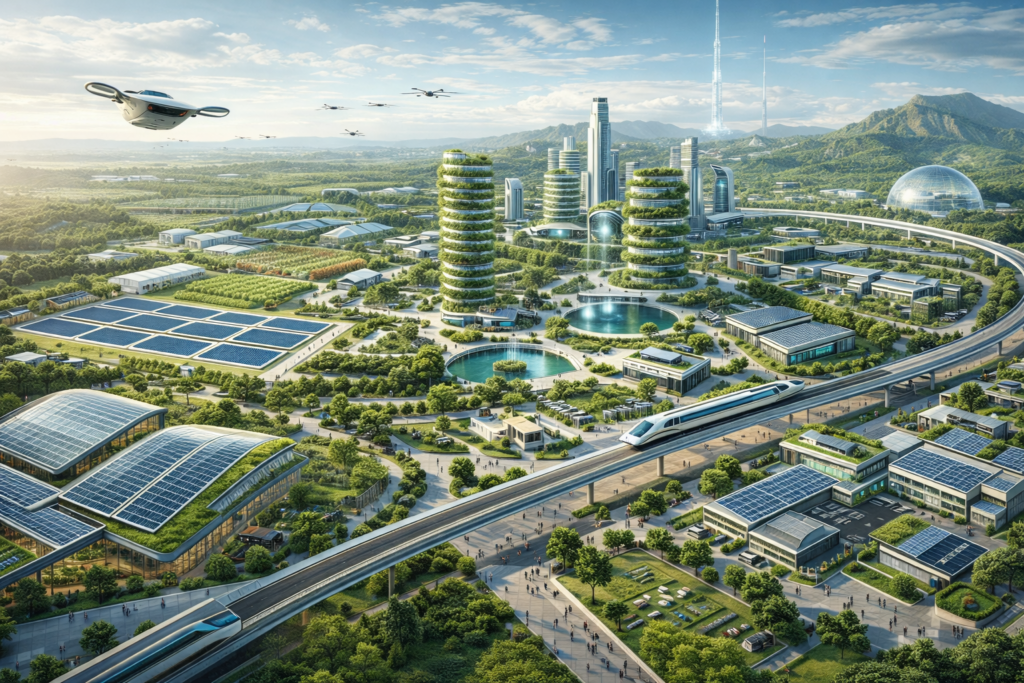
Sustainable Change Through Working Smarter, Not Harder

Sustainable Change Through Working Smarter, Not Harder

Reclaiming Humanity’s True Potential

We live in a defining era of human history — a time not only of innovation and technological growth, but of deep reflection.

For generations, humanity has been conditioned to believe that progress comes only through relentless struggle — working harder, pushing further, sacrificing more.

But today, a new realization is emerging:


True sustainable change will not come from exhaustion — it will come from awakening.

From working smarter.
From building consciously.
From aligning human effort with long-term purpose.

Seeing the World for What It Is

To create meaningful change, we must first see reality clearly — both its promise and its failures.

Across decades, people have witnessed corruption, inequality, systemic inefficiencies, and the erosion of public trust. Systems designed to serve humanity have, in many cases, fallen short of their purpose.

Societies have been shaped by categorization and division — people labeled, sorted, and grouped in ways that often limit rather than empower.

Through social conditioning and institutional programming, humanity has too often been diverted from its true potential:

  • Encouraged to compete instead of collaborate
  • Distracted from innovation
  • Conditioned into dependency
  • Separated rather than united

Yet our differences — cultural, intellectual, and creative — are not weaknesses.

They are humanity’s greatest strength.

The Awakening of Human Responsibility

A global shift in awareness is underway.

People are beginning to recognize that real power does not live solely within governments or institutions — it lives within communities, innovators, builders, and visionaries willing to take responsibility for the future.

This perspective is not anti-government.

Governance plays an essential role in structure and regulation.

But there is a clear distinction between systems that serve the people and systems weakened by corruption, inefficiency, or unaccountable influence.

When systems fail, humanity must not fail with them.

Instead, we must innovate beyond them — building new frameworks grounded in:

  • Transparency

  • Sustainability

  • Equality

  • Opportunity

  • Shared prosperity

Working Smarter: Designing Sustainable Ecosystems

Working smarter means rethinking how we live, produce, and grow.

It means transitioning:

  • From exploitative economies → to regenerative ones
  • From dependency → to self-sufficiency
  • From scarcity thinking → to abundance creation

Sustainable development is not limited to renewable energy or eco-architecture.

It is about designing integrated human ecosystems — environments where people can thrive socially, economically, and spiritually.

Systems that provide:

  • Meaningful employment
  • Skills training and development
  • Secure housing
  • Agricultural food systems
  • Education access
  • Community belonging

This is sustainable empowerment — not aid, but opportunity.

A New Frontier for Humanity

Humanity now stands at a crossroads.

Some will hold onto familiar systems — even if those systems are failing.

Others — the pioneers — will step forward into new paradigms of living, working, and building.

This is not a divide rooted in conflict, but in consciousness.

A difference between those waiting for change…
And those choosing to create it.

History has always been shaped by pioneers willing to imagine and build new societal models.

Today is no different.

Revitalizing Forgotten Regions

One of the greatest opportunities for sustainable change lies in the revitalization of rural and underdeveloped regions around the world.

Many of these areas are:

  • Population-deprived

  • Industry-deprived

  • Economically overlooked

  • Infrastructure-limited

By introducing integrated sustainable development models into these regions, we can:

  • Repopulate communities

  • Create localized industry

  • Deliver training and employment

  • Build housing ecosystems

  • Establish food and energy security

This is not charity.

This is dignified economic activation.

It offers individuals and families a genuine fresh start — built on participation, ownership, and growth.

Planning the Future Begins Now

The future is not something that arrives by chance.

It is designed through intentional action taken today.

Every sustainable home built…
Every training center opened…
Every agricultural system developed…
Every ethical industry launched…

…lays the foundation for the civilization future generations will inherit.

Planning ahead is no longer optional — it is a shared human responsibility.

A Call to Conscious Action

Humanity stands at a defining threshold.

We can continue repeating cycles of division, dependency, and systemic failure…

Or we can choose a different path:

  • Freedom over control

  • Equality over exploitation

  • Peace over conflict

  • Sustainability over short-term gain

Sustainable change begins when individuals and communities make a conscious decision to act — to build systems that honor both people and planet.

To work smarter.
To live consciously.
To create lasting impact.

The future is not written for us.

It is built by us.

And the time to begin is now. Have a look at the future in Sustainable Green Economic with ECAHLI

Petrus Van Der Merwe - Author - Founder CEO ECAHLI and Humanity Unite International
Author - Founder - CEO - ECAHLI

Petrus Van Der Merwe

I’m not here to fit the system — I’m here to replace it with sustainable green economies that restore our humanity and brings balance to peoples lives for generations to come..

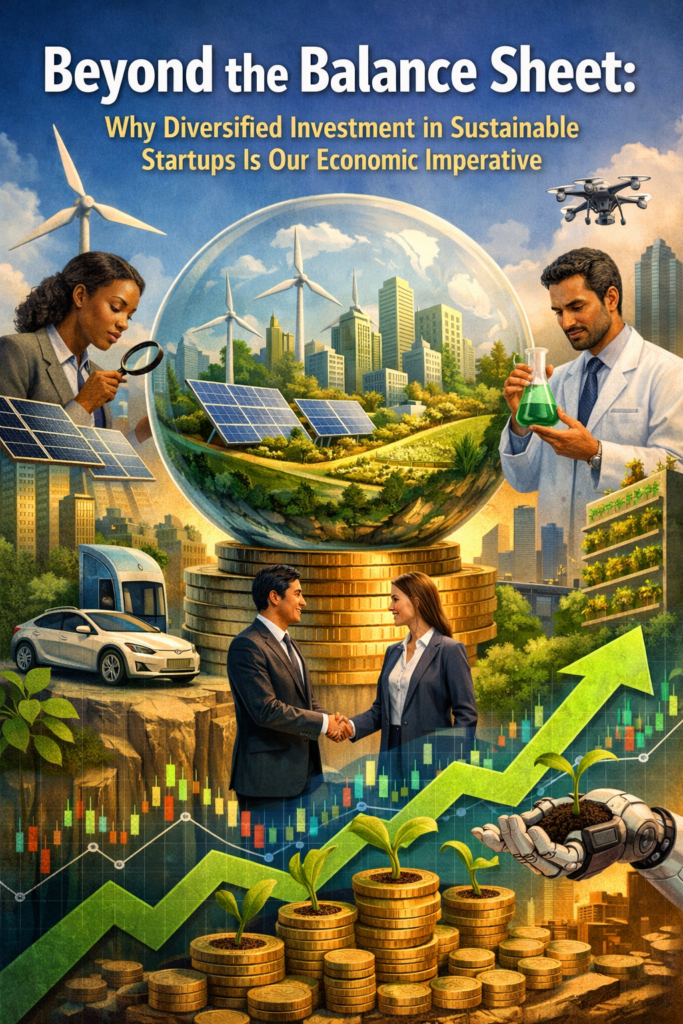
Beyond the Balance Sheet: Why Diversified Investment in Sustainable Start-ups Is Our Economic Imperative

Beyond the Balance Sheet: Why Diversified Investment in Sustainable Startups Is Our Economic Imperative

In an era of escalating climate challenges, widening inequality, and persistent rural depopulation, the global investment landscape faces a critical paradox: while capital flows abundantly toward established tech giants and speculative assets, transformative solutions addressing humanity’s most pressing needs remain chronically underfunded. The consequence of this imbalance is stark—rising unemployment, abandoned communities, and fragmented approaches to problems that demand integrated solutions. The path forward requires a fundamental shift in how we view investment: not merely as wealth accumulation, but as strategic capital allocation toward long-term resilience.

The Peril of Concentration

The adage “don’t put all your eggs in one basket” has never been more relevant. Today’s investment portfolios remain dangerously concentrated in narrow sectors—primarily big tech, financial services, and extractive industries—creating systemic vulnerability when market corrections occur.

n26.com

This concentration exacerbates economic shocks, as witnessed during recent market volatility that disproportionately impacted overexposed investors while sustainable alternatives demonstrated greater resilience. True portfolio diversification extends beyond asset classes to encompass purpose-driven sectors: renewable energy, regenerative agriculture, circular economy models, and integrated community development.

www.triodos.co.uk

These areas don’t just mitigate risk—they actively build societal resilience while generating competitive returns.

The Rural Renaissance Imperative

While urban centers absorb the lion’s share of investment capital, rural regions worldwide face a silent crisis: depopulation, aging infrastructure, and vanishing economic opportunity. Yet these same regions hold untapped potential for sustainable development, food security, and quality-of-life innovation. Forward-thinking initiatives recognize that rural revitalization isn’t charity—it’s strategic economic development. Spain’s “HolaPueblo” program has connected over 100 municipalities with entrepreneurs seeking to establish businesses in depopulated areas.

www.redeia.com

Similarly, Scotland has pioneered island repopulation policies that blend housing incentives with business development support.

pure.sruc.ac.uk

These models prove that with intentional investment, rural communities can transform from “left behind” zones into thriving hubs of innovation and sustainability. press.un.org

Integrated Solutions for Interconnected Problems

The most promising frontier in sustainable development lies not in single-issue fixes, but in holistic models that address housing, employment, education, healthcare, and environmental stewardship as interconnected systems. Projects like ECAHLI (Eco-Community Affordable Housing & Lifestyle Initiative) exemplify this approach—designing self-sustaining community infrastructure that integrates essential pillars of human flourishing within rural contexts.

By simultaneously tackling affordable housing shortages, job creation through local industry development, educational access, and healthcare delivery within ecologically regenerative frameworks, such initiatives avoid the fragmentation that plagues conventional development models.
 
These integrated approaches recognize a fundamental truth: you cannot solve housing crises without addressing employment; you cannot improve healthcare access without considering transportation and community design; and you cannot achieve sustainability without economic viability for residents. The most resilient communities emerge when these elements co-evolve within a single, coherent vision.

The Catalyst Role: Networks That Connect Capital to Purpose

Even the most visionary start-up’s face formidable barriers: regulatory complexity, capital access gaps, and the “valley of death” between prototype and scale. This is where purpose-driven networks become indispensable catalysts. Organizations like the Conscious Enterprises Network operate at the intersection of capital and consciousness—connecting impact investors with vetted initiatives while providing the mentorship, governance frameworks, and collaborative ecosystems start-up’s need to mature responsibly.

Such networks don’t just facilitate transactions; they foster ecosystems where businesses support businesses and investors become partners in transformation rather than passive funders.

A Call for Conscious Capital Allocation

The data is unequivocal: sustainable investment is no longer a niche preference but an economic imperative. Climate technology investment continues rising as a proportion of all startup funding, with renewable energy, carbon management, and sustainable agriculture emerging as innovation drivers.
pulsar.vc
Yet significant capital gaps persist—particularly for early-stage ventures tackling systemic challenges like rural revitalization and integrated community development.
www.b4i.unibocconi.it
 
This moment demands more than passive ESG screening. It requires active capital allocation toward:
  • Diversified portfolios spanning multiple sustainable sectors to build resilience
    www.home.saxo
  • Patient capital that recognizes community-scale projects require longer horizons than app-based startups
  • Due diligence beyond financials—evaluating social impact, governance integrity, and ecological regeneration potential
  • Collaborative investment where stakeholders co-create solutions rather than extract value

United We Rise

The challenges before us—climate disruption, inequality, rural abandonment—are not isolated problems but symptoms of a fragmented economic paradigm. Solutions exist at the intersection of innovation, compassion, and systems thinking. Supporting start-up’s that weave together housing, work, education, healthcare, and sustainability isn’t idealism—it’s pragmatic economics for the 21st century.
 
As unemployment figures climb globally and communities fracture, we face a choice: continue channelling capital into narrow sectors that amplify systemic risk, or courageously invest in the integrated, regenerative models that build genuine resilience. The latter path requires patience, discernment, and collaboration—but it offers something the former cannot: a future where prosperity is shared, communities thrive, and economic activity regenerates rather than depletes.
 
The time for siloed thinking has passed. The era of conscious, diversified investment in human-scale solutions has arrived. United in purpose, diversified in approach, and committed to long-term flourishing—we rise together.


Disclaimer: This article discusses sustainable investment principles and emerging development models. Potential investors should conduct thorough due diligence on any start-ups or initiative before committing capital. Investment in early-stage ventures carries significant risk, and past performance does not guarantee future results.

From Polycrisis to Prosperity:

How Eco-Communities Are Rewriting Rural Development

From Polycrisis to Prosperity:

The world isn’t facing one crisis—it’s facing all of them at once.

In 2026, we’re navigating what experts call a “polycrisis”: interlocking wars, economic instability, climate disasters, and humanitarian emergencies that don’t just coexist—they amplify each other. Trade wars drive up food prices. Debt crushes climate adaptation. Conflict displaces millions into regions already straining under their own burdens.

Traditional aid isn’t working. Band-aid solutions can’t heal systemic wounds.

What if the answer isn’t at the top, but at the grassroots?

The Polycrisis Reality Check

The numbers tell a sobering story:

  • Geopolitical fragmentation: From U.S.-China tensions to active conflicts in Sudan, Gaza, and Haiti, instability is displacing millions and straining global resources
  • Economic stagnation: Global growth limps along at 2.6%, while developing nations grapple with crushing debt and persistent inflation
  • Climate acceleration: La Niña-driven floods devastate food production in South Sudan and Burkina Faso, triggering migration and social unrest
  • The feedback loop: Each crisis intensifies the others, creating a vicious cycle pushing vulnerable regions toward collapse

This isn’t pessimism—it’s the reality millions face daily.

Enter ECAHLI: A Different Kind of Solution

While global institutions debate policy, something radical is happening in rural Paraguay.

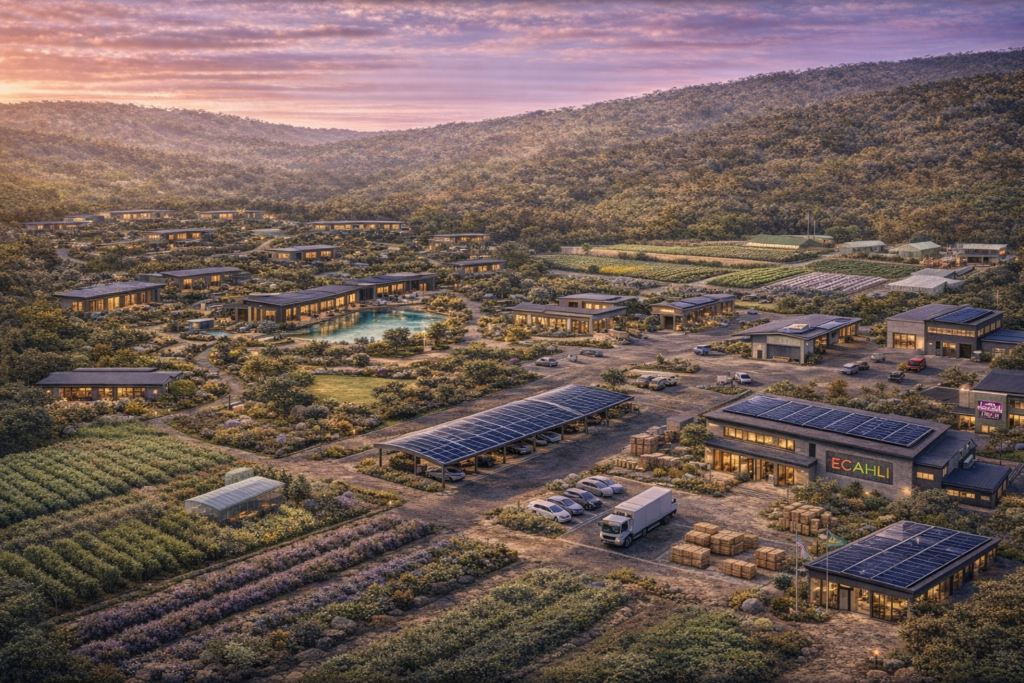
ECAHLI (Eco-Community Alternative Housing and Lifestyle Initiative) isn’t another charity or aid program. It’s a blueprint for self-sustaining communities that address polycrisis root causes simultaneously.

Picture this: Off-grid villages where residents build their own prosperity through:

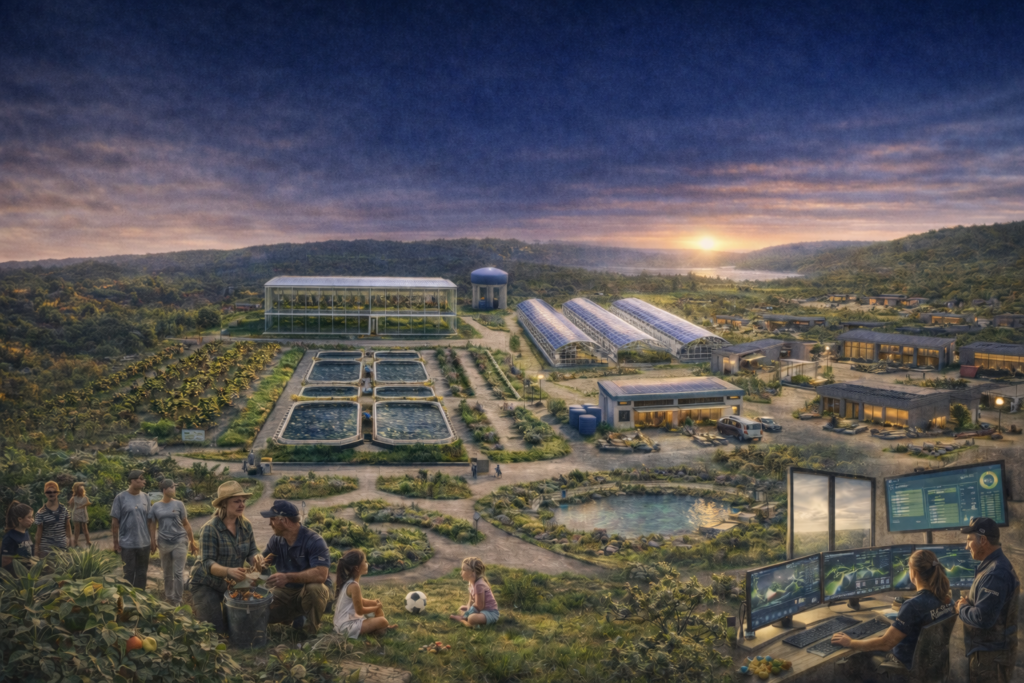
  • Hydroponic and aeroponic farming that generates food abundance regardless of climate shocks
  • Green manufacturing enterprises with profit-sharing models that create real wealth, not dependency
  • Sustainable housing powered by renewable energy, resilient to environmental stress
  • Skills training ecosystems that transform underemployment into entrepreneurship

The difference? Every element tackles multiple crisis points at once.


Global ChallengeECAHLI Solution
Economic Debt & UnemploymentProfit-sharing businesses & comprehensive skills training
Food InsecurityLocal hydroponics/aeroponics for year-round abundance
Climate VulnerabilityOff-grid green infrastructure & climate-resilient design
Social Unrest & MigrationCommunity-based prosperity reducing rural exodus

Why Latin America? Why Now?

Underdeveloped Latin American regions mirror the global polycrisis in microcosm—rural poverty, underemployment, climate threats, and limited opportunity driving mass migration.

But they also offer something crucial: proof of concept potential.

ECAHLI’s inaugural community launches in Paraguay with a bold commitment: the 90-Day Latin America Cross-Continent Challenge. This intensive push aims to prototype, fund, and deploy Phase 1, demonstrating that this model can work anywhere.

The design is deliberately modular and industry-agnostic. What works in Paraguay can scale to Bolivia, Honduras, or anywhere rural communities need revitalization.

The Ripple Effect: From Villages to Regions

Here’s what makes ECAHLI different from traditional development:

It creates networks, not isolated projects. As one community thrives, it connects to neighbors, sharing knowledge, resources, and economic opportunity. The impact multiplies organically.

It’s universally adaptable. The same framework that works in Latin American villages can deploy in African hinterlands or Asian rural areas—anywhere communities need self-sufficiency.

It attacks root causes. By building local food security, economic independence, and climate resilience simultaneously, ECAHLI doesn’t just treat symptoms—it removes the conditions that create crisis vulnerability.

From Theory to Ground Truth

This isn’t speculative. ECAHLI’s 2026 developments show Paraguay groundwork accelerating. The infrastructure is taking shape. The training programs are launching. The first residents are preparing to build their futures.

The question isn’t whether it can work—it’s how fast we can scale it.

The Invitation

The polycrisis won’t solve itself. Top-down approaches have had decades to work.

What if the solution is empowering communities to build their own resilience from the ground up?

ECAHLI represents a fundamental shift: from aid dependency to self-sufficiency, from crisis management to crisis prevention, from isolated interventions to integrated solutions.

The 90-Day Challenge is underway. The blueprint is proven. The need is urgent.

Are you ready to be part of rewriting what’s possible?


Connect with ECAHLI: 🌐 ecahli.com 💼 Follow our progress and get involved

Whether you’re an investor seeking impact, a development professional looking for scalable solutions, or simply someone who believes we can do better—let’s talk.

#ECAHLI #SustainableDevelopment #Polycrisis #LatinAmerica #EcoCommunities #RuralDevelopment #ClimateResilience #SocialImpact #Innovation

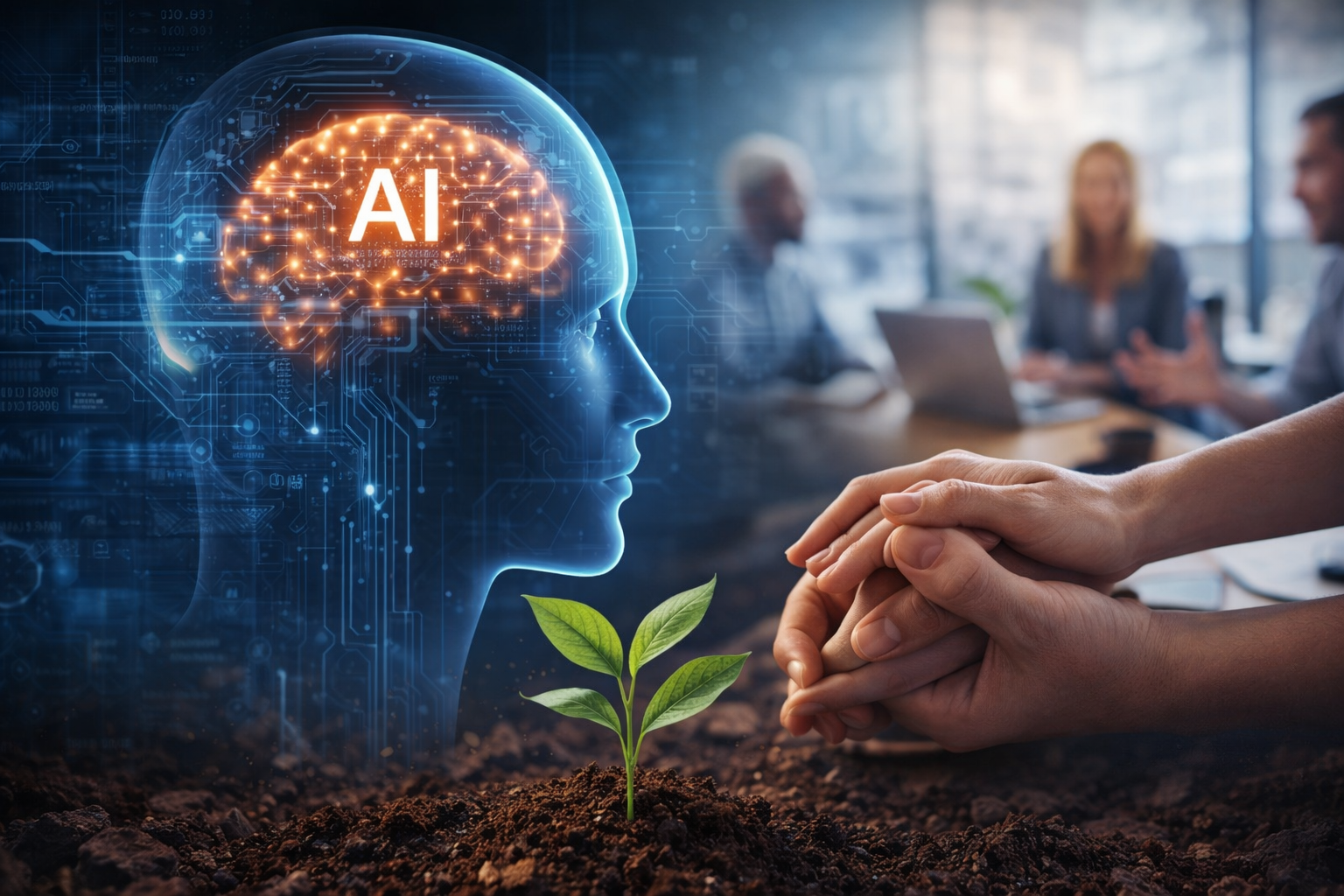
Using AI Without Losing Our Humanity: Building a Smarter, More Human Future

Working Smarter Not Harder

Using AI Without Losing Our Humanity: Building a Smarter, More Human Future

Artificial Intelligence is no longer a distant concept or a future promise. It is here, it is powerful, and it is reshaping how we work, think, and build.

But the real question is not whether we should use AI.
The question is how we use it — and why.

At ECAHLI, we believe AI should never replace human value. Instead, it should protect it, amplify it, and give it room to grow.

Technology Should Serve Humanity, Not Erase It

For generations, progress has been measured by how much faster we could work, how much more we could produce, and how efficiently we could operate. Somewhere along the way, speed replaced meaning, and productivity replaced presence.

AI gives us a chance to correct that.

When used intentionally, AI removes the tedious, repetitive, and time-consuming tasks that drain human energy:

  • Administrative overload

  • Data processing

  • Repetitive reporting

  • Manual coordination

By offloading these tasks to intelligent systems, we don’t become less human — we become more human.

Freeing Time for What Truly Matters

Time is our most limited resource.

By integrating AI into development, operations, and daily work, we free up something incredibly valuable: mental and emotional space.

That space is where:

  • Creativity lives

  • Innovation happens

  • Problem-solving deepens

  • Relationships strengthen

  • Families reconnect

  • Communities grow

AI allows us to redirect our energy away from survival-mode work and back toward invention, design, collaboration, and care.

This is not about working less — it’s about working with purpose.

Working Smarter, Not Harder — Made Real

“Work smarter, not harder” has long been a slogan. AI finally makes it practical.

When human creativity is paired with intelligent systems:

  • Decisions become clearer
  • Planning becomes more accurate
  • Resources are used more responsibly
  • Mistakes are reduced
  • Innovation accelerates

Humans bring vision, ethics, empathy, and imagination.
AI brings speed, structure, pattern recognition, and scale.

Together, they form something far more powerful than either alone.

AI as a Tool for a Sustainable Future

Sustainability is not just environmental — it is human.

  • A sustainable future requires:
  • Healthier work-life balance
  • Reduced burnout
  • Smarter use of resources
  • Long-term thinking over short-term pressure

AI helps us design systems that are efficient without being exploitative, productive without being dehumanising.

When technology supports people instead of replacing them, sustainability stops being an ideal and starts becoming a lived reality.

Choosing Integration Over Fear

Fear often arises when technology feels imposed instead of integrated.

The goal is not to let AI decide for us.
The goal is to let AI support us — while humans remain responsible for values, direction, and impact.

We must choose:

  • Conscious adoption over blind automation
  • Collaboration over replacement
  • Ethics over efficiency alone

The future doesn’t belong to machines.
It belongs to humans who know how to use machines wisely.

A Future Where Humanity Leads

At its best, AI gives us back what modern systems have slowly taken away:

  • Time
  • Focus
  • Presence
  • Creative freedom

When we use AI to handle what machines do best, humans are finally free to do what only humans can do:

  • Create.
  • Invent.
  • Care.
  • Build meaningful lives.

That is the future worth designing.

Where These Principles Come to Life

At ECAHLI, these principles are not theoretical — they are actively shaping how we design communities, work environments, and development systems.

We use AI and intelligent systems to remove unnecessary complexity, streamline operations, and reduce administrative burden, so that people can focus on what truly matters: building, learning, creating, and living meaningful lives.

By combining technology with human-centred design, ECAHLI aims to create environments where innovation supports dignity, productivity supports balance, and progress never comes at the cost of humanity.

This is not about choosing between technology and people.
It is about ensuring technology works in service of people.

Award-Winning Self-Sustainable Community Design

Designing the Future: Award-Winning Self-Sustainable Community Design

By Petrus Van Der Merwe
Award-winning self-sustainable community design specialising in sustainable construction, housing, agriculture, renewable energy, and long-term resilience.

The World Needs More Than Green Ideas — It Needs Working Systems

Sustainability is no longer a trend.
It is a necessity.

Across the world, governments, investors, developers, and communities are searching for solutions that go beyond short-term fixes — solutions that actually work, endure economic cycles, respect human dignity, and regenerate both land and lives.

This is where my work begins.

I am Petrus Van Der Merwe, an award-winning self-sustainable community designer and long-term sustainability specialist, focused on creating fully integrated, real-world systems — not concepts, not theories, but operational communities built to thrive for generations.

What I Design: Complete Self-Sustainable Ecosystems

My work is not limited to individual buildings or isolated technologies. I design complete, interconnected ecosystems where housing, agriculture, energy, work, education, and security function together as one resilient system.

Sustainable Construction

I specialise in advanced sustainable construction methods, including:

  • Low-impact and regenerative materials
  • Modular and scalable building systems
  • 3D-printed and alternative construction technologies
  • Climate-adapted design for diverse regions

Every structure is designed to reduce lifetime environmental impact while increasing durability, efficiency, and affordability.

Each project is designed for long-term independence, economic viability, and human wellbeing.

Sustainable Housing

Housing is not just shelter — it is the foundation of dignity and stability.

My housing designs focus on:
  • Energy-efficient, climate-responsive homes
  • Affordable yet high-quality living environments
  • Community-oriented layouts that encourage connection
  • Long-term maintenance reduction and cost control

The goal is simple: homes people can afford, maintain, and be proud of — long term.

Sustainable Agriculture

True sustainability starts with food security.

I design agricultural systems that integrate:

  • Regenerative farming practices
  • Community-based food production
  • Aquaponics, agroforestry, and mixed-use farming
  • Local employment and skills development

These systems reduce dependency on external supply chains while restoring land health and food sovereignty.

Sustainable Renewable Energy Solutions

Energy independence is non-negotiable in future communities.

My work includes:
  • Hybrid renewable energy systems (solar, wind, hydro, emerging tech)
  • Microgrids and off-grid energy design
  • Energy storage and smart load management
  • Scalable infrastructure for future expansion

The result: stable, affordable, and resilient energy systems that protect communities from rising costs and grid failures.

Security & Resilience by Design

Security is not about fences alone — it’s about intelligent planning.

I design communities with:
  • Natural surveillance through layout and visibility
  • Controlled access without creating “fortress” environments
  • Infrastructure resilience against social, economic, and environmental shocks
  • Human-centred safety that preserves freedom and dignity

Security is built into the system — not added as an afterthought.

Award-Winning, Field-Tested, and Future-Focused

My work has gained recognition because it is practical, scalable, and deeply human. I do not design for trends — I design for decades.

Every project is guided by:

  • Long-term sustainability planning
  • Economic realism and operational feasibility
  • Social impact and poverty prevention
  • Repopulation and revitalisation of underdeveloped regions

These are not abstract ideals — they are measurable outcomes.

Who I Work With

My services are tailored for:

  • Governments and municipalities
  • Private investors and developers
  • NGOs and humanitarian initiatives
  • Visionaries seeking to build intentional communities
  • Regions facing depopulation, housing shortages, or economic decline

Each engagement is highly customised, grounded in local realities, and built for long-term success.

Building What Comes Next

The future will not be built by those who talk the loudest —
it will be built by those who design systems that endure.

If you are seeking a sustainability partner who understands construction, energy, agriculture, housing, security, and human systems as one, then we are already aligned.

The next generation of communities must be self-sufficient, resilient, and deeply human.

That is the work I do.

Let’s Design the Future — Properly

If you would like to explore collaboration, consulting, or community development projects, I invite you to connect through petrusvdmerwe.com.

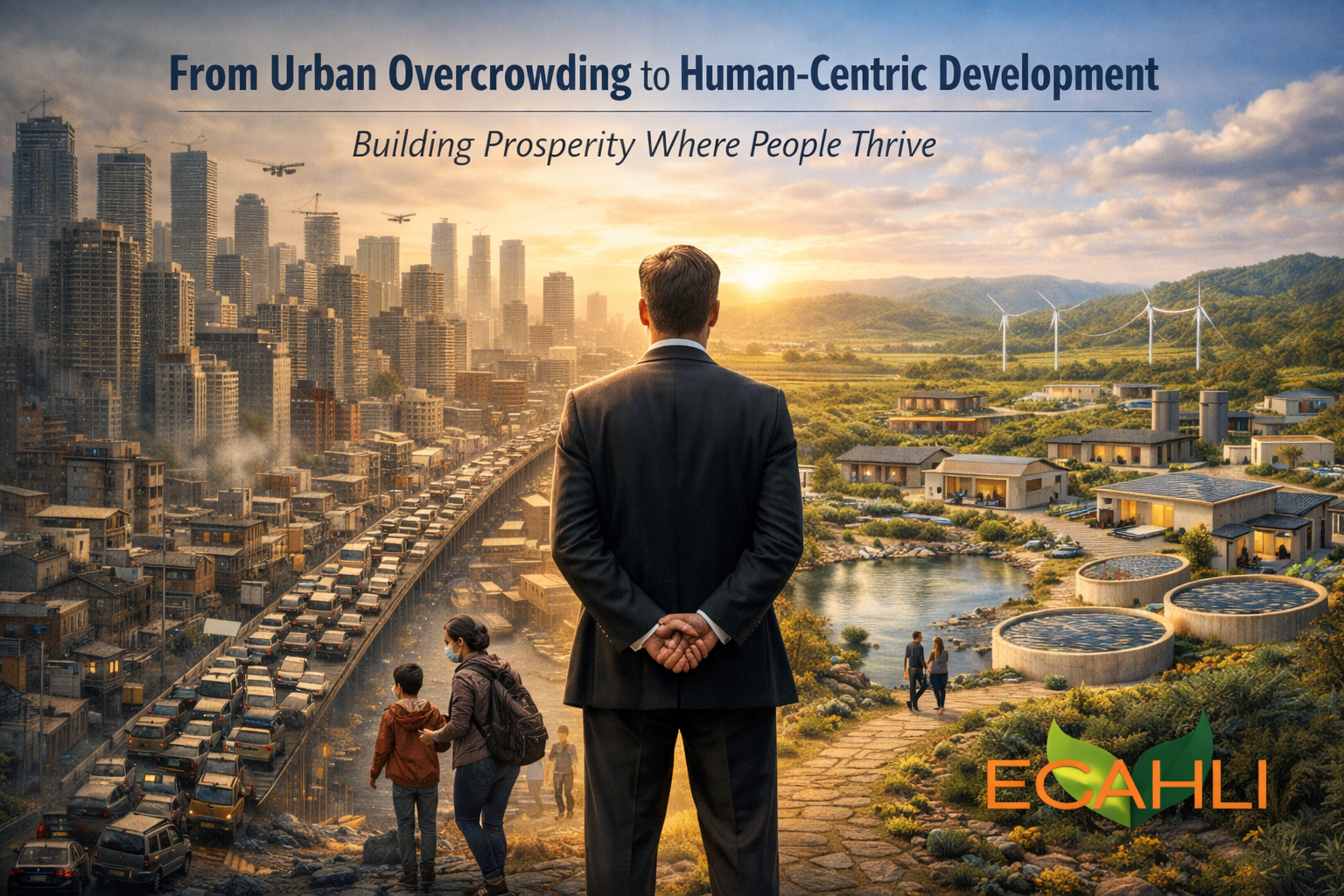
From Urban Overcrowding to Human-Centric Development

From Urban Overcrowding to Human-Centric Development

From Urban Overcrowding to Human-Centric Development

From Urban Overcrowding to Human-Centric Development

Why the Future Belongs to Nations That Invest in People, Not Just Cities

Across the globe, governments and investors are facing a growing contradiction.

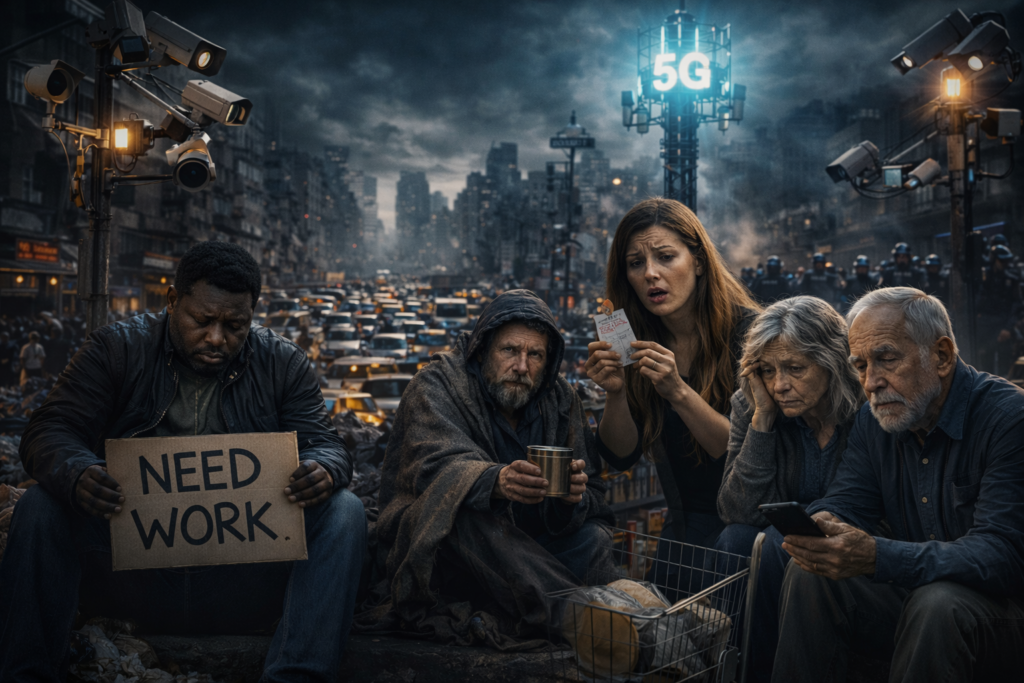
Cities are overcrowded, overstretched, and increasingly expensive to maintain — while vast rural regions and smaller towns are emptying out, underutilised, and economically stagnant.

More than 56% of the world’s population now lives in urban areas, a figure projected to rise to nearly 70% by 2050. Infrastructure systems — housing, transport, healthcare, utilities, and social services — were never designed to absorb this level of concentrated growth.

At the same time, many countries are experiencing depopulation outside their major cities. Entire regions are losing working-age populations, talent, and long-term economic viability.

This is not a coincidence.
It is the direct result of how development has been designed for decades.

The Real Issue Is Not Population — It Is Structure

Urban overcrowding is often treated as a housing problem.
Rural decline is treated as a demographic problem.

In reality, both stem from the same root cause:

Opportunity has been centralised instead of distributed.

When work, innovation, education, and capital are concentrated in a few urban hubs, people have no choice but to follow — even when cities can no longer support them with dignity or stability.

The consequence is predictable:

  • Cities absorb pressure they cannot sustain
  • Rural regions lose relevance and investment
  • Governments face rising costs with diminishing returns

What is missing is not funding.
It is a different development model.

A Different Way Forward: Human-Centric Development

My work focuses on designing and implementing human-centric development systems — frameworks that rebalance population, industry, and opportunity in a way that strengthens national resilience rather than weakening it.

Instead of asking, “How do we expand cities further?”
We ask, “How do we build places where people can genuinely thrive?”

This approach is built on a few fundamental principles:

  • People are economic assets, not social liabilities
  • Talent exists everywhere, but opportunity does not
  • Industry should follow human potential — not the other way around
  • Long-term stability comes from decentralisation, not concentration

What My Services Focus On

I work with governments, institutions, and investors to:

  • Reduce pressure on overcrowded urban centres
  • Repopulate rural and underdeveloped regions with purpose
  • Identify and support individuals with skills, ideas, and entrepreneurial capacity
  • Build integrated ecosystems of housing, work, training, and industry
  • Create long-term, self-sustaining economic zones

This is not relocation for its own sake.
It is structured regeneration — aligning people, infrastructure, and industry into systems that produce measurable outcomes.

ECAHLI: From Strategy to Execution

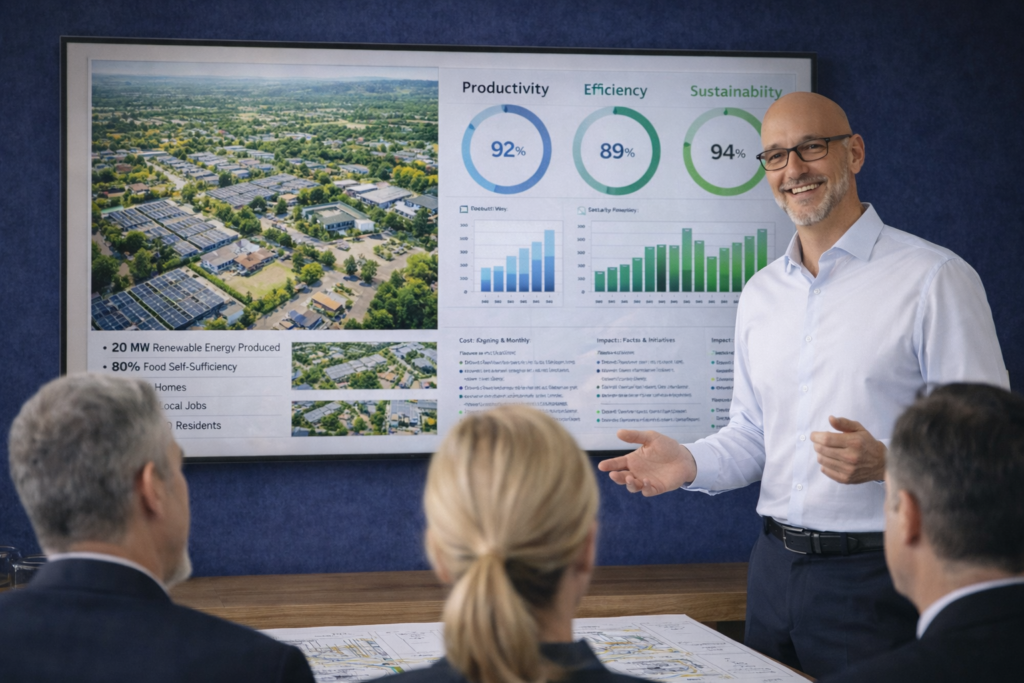
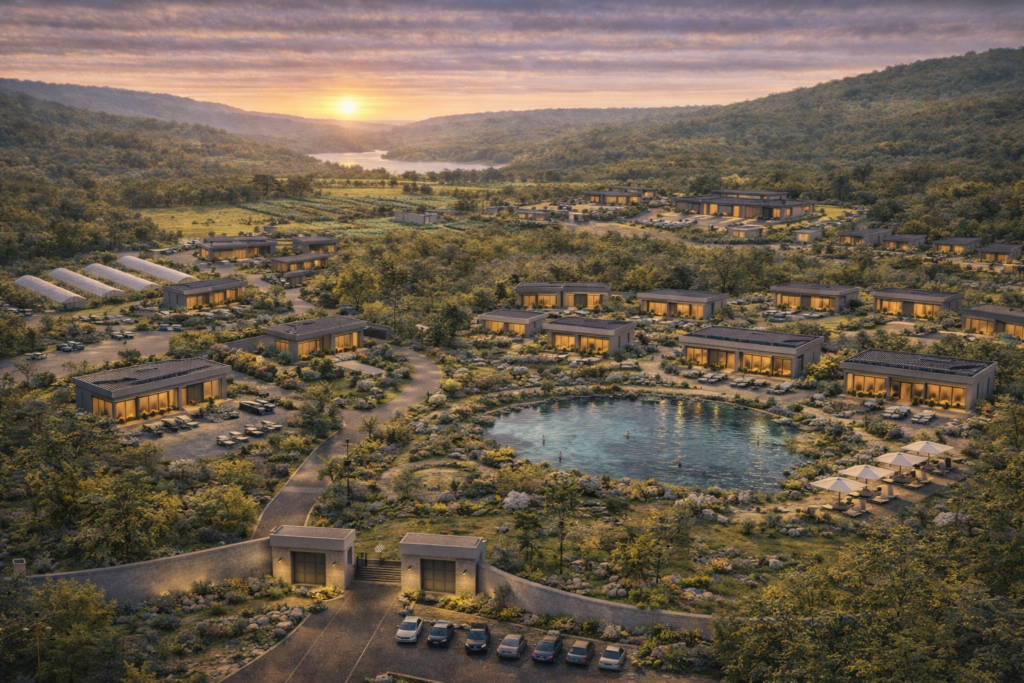
This philosophy is executed through ECAHLI — a scalable development framework designed to transform underutilised regions into productive, dignified, and economically resilient communities.

ECAHLI integrates:

  • Sustainable housing
  • Skills development and training
  • Local manufacturing and industry
  • Governance and community structure
  • Long-term economic participation

Rather than treating people as beneficiaries, ECAHLI positions them as contributors, builders, and stakeholders.

This shift is critical.

When people have ownership, purpose, and the ability to create value, dependency declines — and resilience increases.

Why This Matters to Governments and Investors

Countries such as Italy, Portugal, Uruguay, and many others face a similar strategic challenge:

  • Aging and declining rural populations
  • Youth migration toward cities or abroad
  • Underutilised land, infrastructure, and public assets
  • Increasing pressure on urban systems and public budgets

Human-centric, decentralised development offers a way to:

  • Rebalance population distribution
  • Retain and attract talent
  • Activate dormant regions
  • Create new industrial and innovation hubs
  • Reduce long-term social and infrastructure costs

For governments, this means greater national stability.
For investors, it means long-term, real-economy value creation.

The Shift Required

The future will not be built by expanding what is already failing.

It will be built by leaders willing to:

  • Rethink where development happens
  • Invest in people as drivers of growth
  • Design systems that reward contribution, not dependency

This is not ideology.
It is pragmatic, strategic, and increasingly unavoidable.

A Conversation Worth Having

If you are a policymaker, institutional partner, or long-term investor seeking solutions to:

  • Urban overcrowding
  • Rural depopulation
  • Talent loss
  • Economic imbalance

Then this is not a theoretical discussion — it is a strategic necessity.

To learn more about my work and development approach, visit:
👉 https://petrusvdmerwe.com/

The nations that thrive in the coming decades will not be those that build bigger cities —
but those that build better systems for people