The global economy stands at a historic turning point. Decades of rapid growth, technological advancement, and global integration have delivered unprecedented wealth and lifted billions out of poverty. Yet beneath this progress lie mounting structural weaknesses: rising inequality, unsustainable debt, climate instability, geopolitical fragmentation, and technological disruption.
The question is no longer whether the global economic model faces strain — it is whether it can adapt fast enough to avoid prolonged instability.
This article examines the major problems confronting the global economy today and explores practical, systemic solutions capable of delivering long-term resilience, equity, and sustainable growth.
After decades of expansion, many advanced economies are experiencing slower productivity growth, aging populations, and declining labour-force participation. Emerging markets face volatile capital flows, commodity dependency, and external debt pressures.
Low productivity growth weakens wage increases, reduces government revenue, and limits investment capacity. In advanced economies, demographic shifts — particularly in Europe and East Asia — are shrinking working-age populations, increasing the fiscal burden on social systems.
Meanwhile, supply chain disruptions exposed during the COVID-19 pandemic and geopolitical tensions have revealed structural fragility in global trade systems.
Investment in productivity-enhancing sectors is essential. This includes:
Digital infrastructure
Advanced manufacturing
Clean energy systems
Education and lifelong workforce retraining
Countries like South Korea demonstrate how sustained investment in innovation and human capital can offset demographic decline.
Policy reform must also encourage:
Labour force participation (especially among women and older workers)
Smart migration systems to address demographic imbalances
Targeted industrial policy to support strategic sectors
Growth must shift from quantity to quality — from expansion driven by extraction and debt toward innovation-driven productivity.
Global debt — sovereign, corporate, and household — has reached historic highs. Years of low interest rates encouraged borrowing, but tightening monetary policy has exposed vulnerabilities.
Emerging economies are particularly at risk. Countries facing high external debt burdens struggle when currencies depreciate and refinancing costs rise. Debt distress can trigger capital flight, austerity cycles, and social instability.
The global financial system remains interconnected and susceptible to cascading shocks.
Debt restructuring frameworks must be modernized and accelerated.
Multilateral institutions such as the International Monetary Fund and World Bank need expanded capacity and reform to better support vulnerable nations.
Greater financial transparency and regulation of shadow banking systems is necessary.
Long-term fiscal discipline must be paired with strategic public investment — not austerity alone.
Sustainable public finances require growth, not just cuts.
Wealth inequality has widened significantly across and within nations. A small concentration of individuals and corporations controls an increasing share of global assets.
Stagnant wages, rising housing costs, and automation-related job displacement have eroded middle-class security. Economic inequality feeds political instability, populism, and declining trust in institutions.
Economic systems perceived as unfair ultimately lose legitimacy.
Progressive tax reform
Closing tax havens and corporate loopholes
Investment in affordable housing and healthcare
Strengthened social safety nets
Universal access to quality education
Nordic economies such as Sweden demonstrate that high competitiveness can coexist with strong social protections.
Inclusive growth is not anti-market — it stabilizes markets by strengthening demand and social cohesion.
The global economy remains heavily dependent on fossil fuels. Climate change introduces systemic risks:
Extreme weather disruptions
Agricultural instability
Infrastructure damage
Insurance market stress
Supply chain volatility
Unchecked climate change threatens trillions in economic losses.
The transition to a low-carbon economy is not merely environmental policy — it is economic modernization.
Key measures include:
Carbon pricing systems
Renewable energy expansion
Electrification of transport
Green industrial policy
Climate adaptation investment
The European Union Green Deal illustrates how climate policy can function as a growth strategy.
Clean energy investment is increasingly cost-competitive and job-creating. The transition must be accelerated but managed equitably.
Globalization is evolving into regionalization. Trade tensions between the United States and China have reshaped supply chains. Sanctions, export controls, and strategic decoupling are redefining global trade architecture.
This fragmentation reduces efficiency, increases costs, and heightens uncertainty.
While strategic diversification is rational, complete fragmentation is economically destructive.
Solutions include:
Strengthening multilateral trade frameworks
Modernizing the World Trade Organization
Building resilient, diversified supply chains
Establishing guardrails for economic security without total decoupling
Global cooperation remains essential for financial stability, climate response, and technological governance.
Artificial intelligence, robotics, and automation are reshaping labour markets at unprecedented speed. Productivity gains may increase, but displacement risks are real.
Without proactive adaptation, automation could deepen inequality and fuel unemployment in certain sectors.
Massive investment in reskilling and lifelong learning
Public-private workforce partnerships
Updating education systems for digital fluency
Portable benefits for gig and nontraditional workers
Technology must augment human productivity — not replace human dignity.
Governments that treat education as continuous infrastructure rather than a one-time phase will adapt best.
Pandemics, wars, and climate events have exposed over-optimized supply chains. Efficiency-focused globalization reduced costs but sacrificed resilience.
Semiconductor shortages and food supply disruptions demonstrated how concentrated production creates systemic risk.
Strategic diversification (“China+1” models)
Domestic manufacturing capacity in critical sectors
Regional trade partnerships
Digital supply chain transparency
Resilience may increase costs marginally but reduces catastrophic vulnerability.
Economic systems depend on trust — in markets, governments, central banks, and institutions. When citizens perceive corruption, inequality, or incompetence, economic coordination weakens.
Declining trust reduces investment, tax compliance, and civic cooperation.
Transparent governance
Anti-corruption enforcement
Evidence-based policymaking
Clear communication from central banks
Public participation in economic planning
Institutional credibility is economic infrastructure.
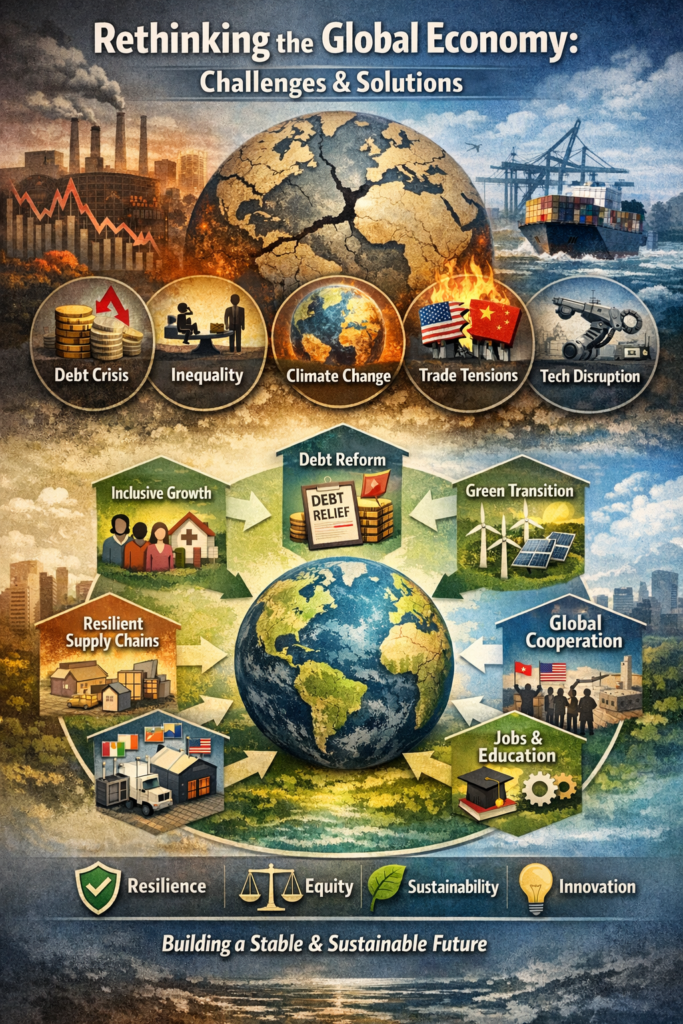
No single reform will stabilize the global economy. The challenges are interconnected:
Debt interacts with inequality.
Climate risk interacts with financial stability.
Technology interacts with labour markets.
Geopolitics interacts with trade and inflation.
Solutions must therefore be coordinated across fiscal policy, monetary policy, industrial strategy, social protection, and international cooperation.
The next phase of economic development must prioritize:
Resilience over short-term efficiency
Inclusion over concentrated wealth
Sustainability over extraction
Innovation aligned with public good
he global economy is not collapsing — but it is transforming. The coming decade will determine whether that transformation is chaotic or strategic.
Countries and institutions that invest in human capital, embrace clean energy, modernize governance, and strengthen social cohesion will likely emerge more competitive and stable.
Economic reform today is not optional — it is preventative.
The central challenge is not the absence of solutions. It is political coordination, long-term thinking, and collective will.
History shows that periods of disruption often precede renewal. The question is whether policymakers, businesses, and citizens can align around a shared economic vision — one that balances prosperity with stability, and growth with sustainability.